
 Thomas Harrison
Informa TechTarget and The Sherpa Group Join Forces to Launch ‘Partner Demand Assurance’
 Thomas Harrison: Aug 6, 2026, 2:10:56 PM
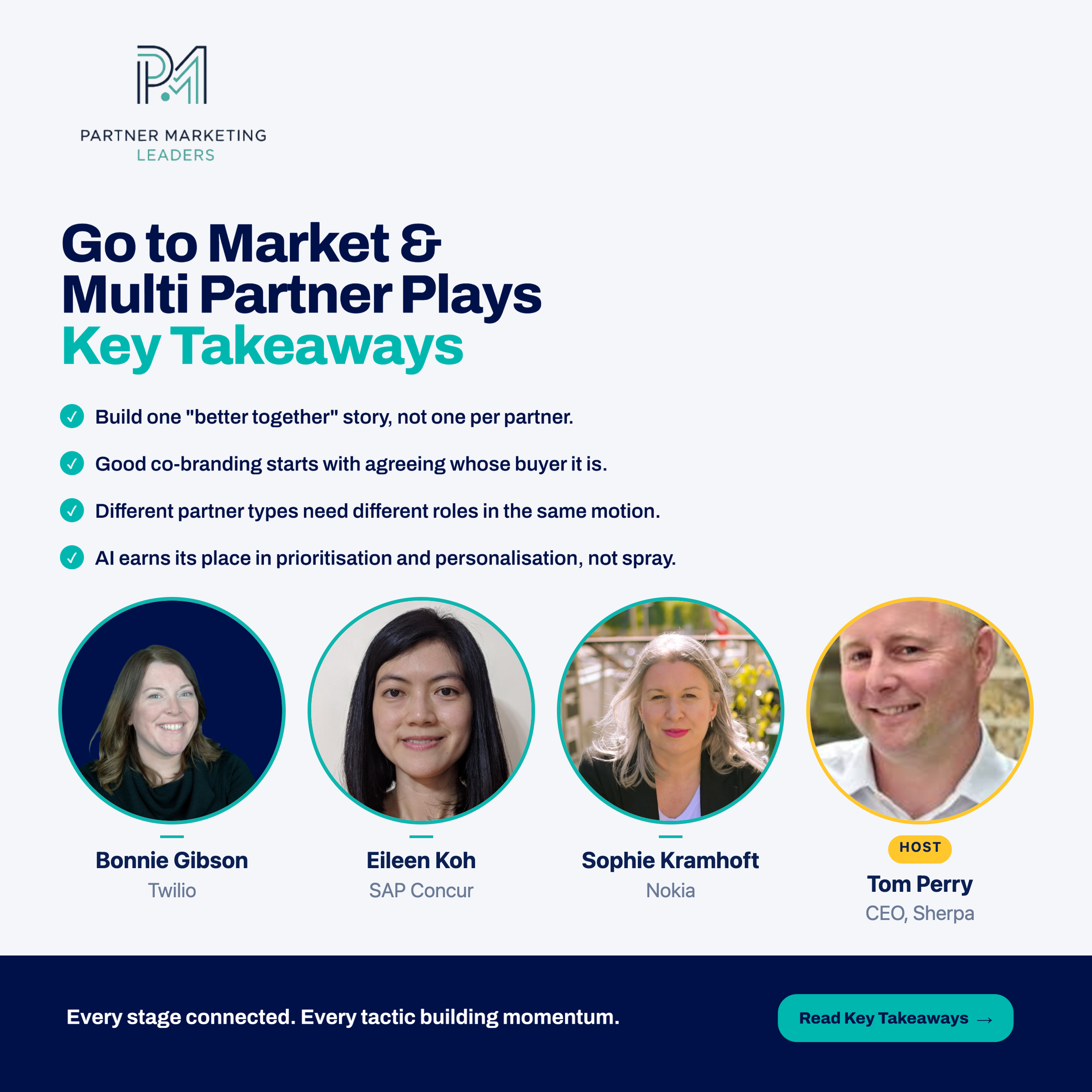
Building the better together story: what to settle before you write a word, how to serve four partners who all want something different, and where AI is genuinely earning its keep.
PANELISTS:
-1.png?width=250&height=244&name=Untitled%20design%20(31)-1.png)
SPEAKER · 01
A partner marketing leader at Twilio Segment, focused on ecosystem programmes that turn better together stories into revenue. She works closely with ISVs, SIs, and cloud partners on GTM motions that are practical and measurable.

SPEAKER · 02
A B2B marketing leader with deep expertise across the Asia Pacific Japan region, specialising in partner and customer marketing, demand generation, and digital strategy. At SAP she develops regional GTM strategies, with a particular interest in AI and intent data.
 SPEAKER · 03
A partner marketing and go-to-market leader with 25+ years in the IT channel. She drives joint go-to market programmes at Nokia, and previously built partner marketing practices at Cisco and Anap
HOST: .jpeg?width=250&height=250&name=Tom%20Perry%20(1).jpeg)
As the CEO of The Sherpa Group, Tom leads a global, specialist, channel marketing agency that helps technology companies grow their revenue through effective partner marketing, partner assessment, and partner recruitment. With over 20 years of experience in the channel ecosystem, he has a deep understanding of the challenges and opportunities that vendors, distributors, and resellers face in the rapidly evolving tech market.
Vendor-to-partner co-marketing is a well-understood discipline, and two partners is manageable. But once four or five organisations want a campaign together, each with its own brand guidelines, its own KPI, and its own view on whose logo goes first, the work changes shape. This session focused on that shift, keeping a partner marketing lens on a topic that otherwise sprawls across sales and go to-market. We brought together three partner marketers from very different businesses: Bonnie Gibson, who covers tech and SI partnerships at Twilio; Eileen Koh, who leads partner marketing for Asia Pacific at SAP Concur; and Sophie Kramhoft, working with channel partners in a joint go-to-market role at Nokia. The conversation covered better together story creation, co-branding in practice, running a campaign where no two partners want the same outcome, and where AI is genuinely useful today.
Before you can build a better together story, Eileen argued, you have to answer why the partners are coming together at all.
What problem can none of them solve alone? If you cannot answer that in one sentence, you do not have a story yet. You just have a lineup of logos.

"You really have to start with the question underneath the question of why are we coming together, and what specific problem are we going to solve for the customer that none of us can solve alone.If you cannot answer that in one sentence, you do not have a better together story yet. You probably just have a lineup of logos."
Eileen Koh, Director of Partner Marketing, Asia Pacific · SAP Concur
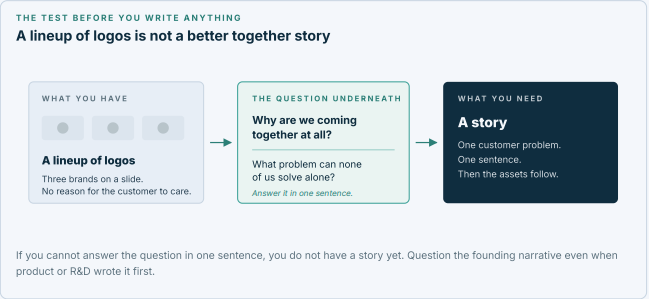
Sophie made the point that the story has often been created by R&D or product development before marketing sees it, which means partner marketers are asked to assemble a narrative without knowing the why behind it. Two equal technology stories being brought together is a different problem from a lead IT company taking several vendors to market, where one narrative stays central and the others wrap around it. Either way, the discipline is to question it, and to bring in a third party or an agency when validating the story is too big a task to do alone.
Co-marketing guidelines matter, particularly for simpler one-to-one or one-to-two partner activity. The rules need deciding before the first asset gets built.
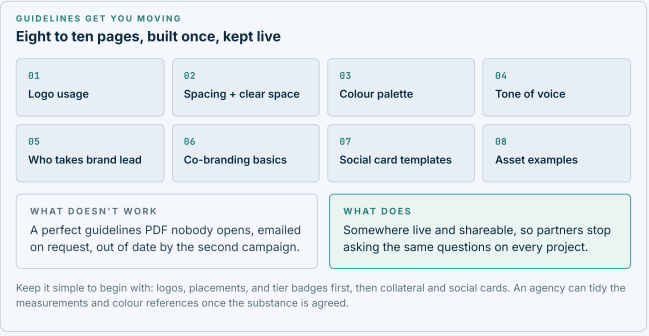
Logo usage, spacing, colour, and tone of voice all need agreeing up front, and it has to be done alongside your brand team. Partners will sometimes object to a standard format because it clashes with their own guidelines, and that is a conversation to have as an agreed exception rather than an argument after the asset ships. When a partner does get co-branding wrong, the panel was unanimous on approaching it as a correction rather than a complaint. Partners generally act with good intentions.
On the question of whose logo comes first, Eileen's answer was to remove the ego from it entirely: default to alphabetical order, and deviate only where there is a clear, agreed reason, such as a lead sponsor funding most of the campaign. Choosing the lead brand is a separate decision, driven by the audience, the offering, and which organisation logically fits the solution being taken to market. Once that is settled, the look and feel follows the lead brand and everyone else appears in partnership with it.
Guidelines only work if partners can find them. An eight to ten page brand kit, built once, is enough to start: logos, co-branding basics, and social card templates. Most people will not read a full guidelines PDF, so Bonnie keeps hers somewhere live and shareable, which stops the same logo requests arriving on every project.
> Bring partners with you when the brand changes
Sophie described a major rebrand where the logo, colours, tone of voice, and strapline all moved. Partners are amplifiers of your brand in the market, so they were given advance sight and briefing sessions rather than a link after the fact. If a partner represents you on their website and in social, the cost of them carrying the old story is yours.
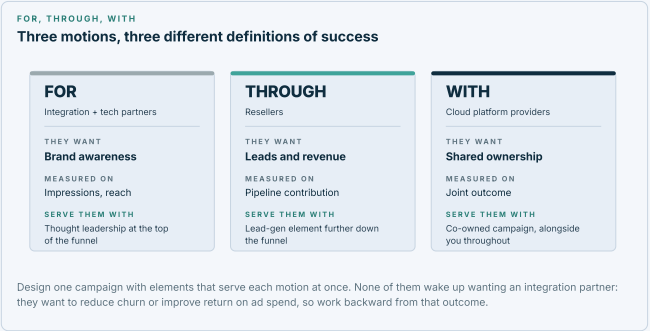
Eileen splits her partners into three motions and designs each campaign so that every motion is served by some element of it.
For partners want awareness and brand association because their solution integrates with hers, and are typically measured on impressions and reach. Through partners, the resellers, want leads and a contribution back to revenue. With partners, such as cloud platform providers, sit alongside her as co-owners of the outcome. Thought leadership serves the for partners at the top of the funnel, while a lead-generation element further down gives the resellers something to catch.
Bonnie described the same problem from the other direction. A hyperscaler providing MDF may simply want its logo on the asset because it drives attendance; a systems integrator wants to know who attended and what their titles were; a smaller ISV wants top-of-funnel association with a bigger brand. One webinar, three definitions of success. Agree a single source of truth for the campaign, so partners are not all reporting in different directions.
"There could be random acts of marketing, chucking logos out there, or really strategic thought. So when I am thinking about the Better Together stories I am trying to drive at Twilio, it is really: you are always thinking about the customer first, what solutions we are providing, and then backing into what partners and ecosystems actually support that."
Bonnie Gibson , Senior Partner Marketing Manager · Twilio
Sophie is building a multi-partner event at a neutral technology lab, and flagged two practicalities that are easy to miss until they bite.
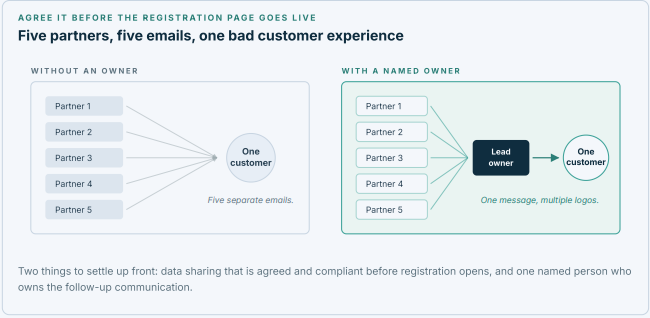
First, data sharing needs to be agreed and compliant before the registration page goes live, otherwise you end up with one partner holding all the customer data and everyone else asking why they cannot see it. Second, and just as important, is who owns the follow-up. A customer getting five separate emails from five separate partners after one event is a bad experience, so one person needs to lead that communication, even if the message carries multiple logos.
THE ONE NOBODY PLANS FOR
Project management gets harder than people expect once four or five partners are in the room, because meetings quietly grow as each partner invites another stakeholder. Agree early who actually needs to be there, and who owns keeping the project on track.
All three panellists are using AI, though more narrowly than the volume of discussion around it suggests.
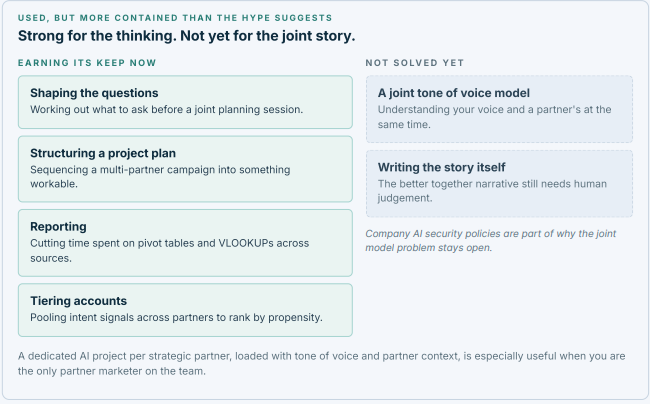
Sophie uses it to shape the right questions and to help structure a project plan, but said the harder problem, a joint model that understands both her company's tone of voice and a partner's, is not solved yet, partly because of her own company's AI security policies.
Bonnie builds a dedicated AI project for every strategic partner or campaign, feeding in tone of voice and partner context so she can move faster before looping in product marketing. Eileen's team uses it for partner-facing enablement assistants and, more experimentally, for pooling intent signals across partners to tier accounts by propensity. On reporting, it has cut the time spent pulling multiple sources into pivot tables.

"It is for us to be very disciplined in partner marketing, and to question, because sometimes an idea has been had about bringing two companies together, but how, where, and why do you take it?"
Sophie Kramhoft, Joint GTM Partner Program Manager · Nokia
Pin it up, share it with your team, bring it to your next joint planning meeting.
The throughline: Multi-partner GTM is less about the assets and more about the agreements: the one-sentence why, who owns what, and whose KPI each element of the campaign is actually serving.
Pick one, run it on your next joint campaign, and see what changes.
Partner Marketing Leaders is a community for partner and channel marketers. Get the details on the next session, share what’s working, and meet your peers. Join us at https://partner-marketing-leaders.circle.so/c/getting-started/welcome-to-partner-marketing-leaders
Thomas Harrison: Aug 4, 2026, 3:24:18 PM