
 Thomas Harrison
The Future of Partner Marketing: On-demand and Key Takeaways
 Thomas Harrison: Oct 30, 2026, 3:49:53 PM
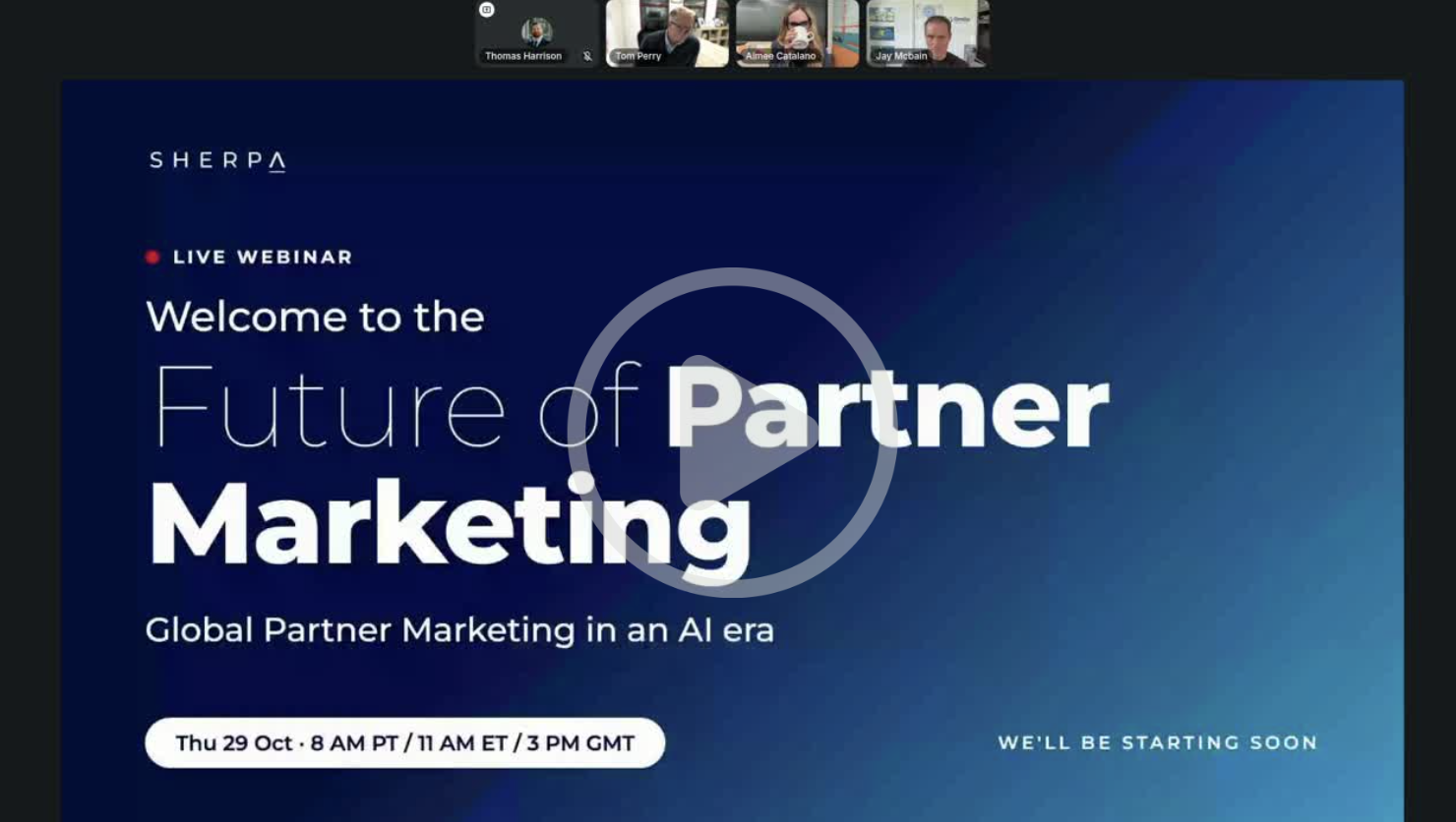
This is the key takeaways document from The future of partner marketing, the 11th session in six years in our Partner Marketing Leaders webinar series. Tom Perry, CEO of The Sherpa Group, introduced the panel at the start.
“I’m joined today by two exceptional panelists. I’m delighted to introduce Aimee Catalano, Managing Director of Global Partner Marketing at Google Cloud, who runs partner marketing at some scale in one of the biggest ecosystems in the world. We’re also joined, for the 11th time, by Jay McBain, Chief Analyst at Omdia, who sees the whole market and will keep us honest with the data. So we have a hyperscaler, an analyst and a practitioner, and hopefully that’s a great mix for everybody.”
Tom Perry, CEO, The Sherpa Group



Partners are now part of nearly every deal, so the question for partner marketers is which moments in the customer journey they show up for. Tom opened with the figure that 96% of IT deals are influenced by partners. Omdia’s Jay McBain added that customers now use an average of 6.3 partners per deal, and that the first 10 to 12 of the 28 moments he tracks are marketing moments.
Trust is earned in those early moments, and Jay framed it as a question of who gets the seat at the table:
Jay McBain, Chief Analyst, Omdia
At Google Cloud, Aimee said the 100% partner attach strategy runs from the top of the company to the bottom. She credited the partner ecosystem for Google Cloud’s growth of more than 100% year over year.
How can we action this?
Map which of the early marketing moments your partners show up in today, and focus investment on the partners best placed to earn trust before the technology choice is made. Assessment tools like Sherpa’s EdisonAI can show where partners are missing from those moments, so you know where support will make the difference.
Tom’s partner marketing agency, Sherpa, has built a partner assessment platform, EdisonAI, that assesses 20,000 partners every year for its benchmark. It covers marketing infrastructure, staffing, skills and alignment with the vendors they work for. He calls the gap they find the missing multiplier. One finding is that 70% of partners don’t have CRM and marketing automation. When a good-quality lead goes to a partner who’s engaged and enabled, Tom said around 85% of those leads reach an outcome of some kind.
Tom Perry, CEO, The Sherpa Group
Jay looked at the same problem from the customer side. Talent is the number one thing customers say slows their AI projects, and Omdia found that 82% of partners aren’t fully ready to grow in AI services. Google responded with a $750 million partner enablement investment. Jay noted that this isn’t MDF or an incentive check. It’s money to close the skills gap so partners can talk to customers by industry, role, geography and outcome.
Aimee explained Google Cloud’s thinking with the image of a stool. There’s no sense investing heavily in marketing if sales isn’t enabled, and no sense selling if your practitioners can’t deliver.
How can we action this?
Assess partners on engagement and capability before you fund them, with tools like Sherpa’s EdisonAI. The Missing Multiplier benchmark found that partners strong on both progressed 85% of funded leads, against under 17% for partners strong on only one. Back the partners set up to act, and pair funding with support for those still building capability, either from your internal team or through Partner Concierge from a partner marketing agency.
Aimee sees hyper-specialization as the biggest opportunity for partner marketers right now. Hyperscalers like Google and the AI companies will never be experts in every micro-industry. They do now provide the platforms and connectors that partners can build on for a specific group of customers. She pointed to Google’s recent Gemini offerings for legal and financial services as an example.
Jay’s example was dry cleaners with three to 10 locations in Vancouver. His team at Omdia tracks 1,012 industries. Google can’t create that level of granularity itself, but the AI layer can. Aimee’s advice was to find product and market fit first, then put your best people on the first five customers so they become references, and only then scale. She also described a joint offer from an ISV, a services partner and a vendor. In her view, that combination could double the investment any one of them would make alone.
ABM is where the cost change is easiest to see. Aimee said an ABM program used to cost around $50,000 and was reserved for the top of the market. AI agents now make it realistic for a whole segment. Tom’s team started partner ABM in 2018 with eight large partners because the tooling didn’t exist. He expects many more partners to get the same treatment within a year.
On AI more broadly, Tom said content is table stakes and AI slop is a process problem you can fix. He sees the bigger gains elsewhere: deciding which partners get money, improving reporting, and helping partners progress each lead with its own context instead of receiving a CSV.
For anyone worried about keeping up, Jay’s advice was this:
How can we action this?
Choose one micro-industry where a partner already has traction and build a joint co-marketing offer with that partner. Use AI to extend ABM to a segment of partners, not just your top handful.
Aimee said Google Cloud’s sales teams used to see marketing’s job as getting them deals and pipeline. Over roughly the last six months, the focus has moved to cross-sell, upsell and usage, and Google is now putting a lot of emphasis on the bottom half of the funnel.
Aimee Catalano, Managing Director, Global Partner Marketing, Google Cloud
Jay explained the change. Two-thirds of the roughly $6 trillion industry is now subscription or consumption and moving toward tokens, so winning a customer often means winning the first 30 days. Deals that were once a million dollars are now closer to $50,000, which puts the weight on upsell and cross-sell. Many of these moments are also becoming agentic, so the next handoff may be to an agent rather than a person. He pointed to Wall Street picking through Google’s earnings for its 108% renewal number, because that’s the customer for life.
MDF hasn’t kept pace. With 6.3 partners around the table, Jay said, at best one collects the money that triggers MDF. The other 5.3 partners doing advisory, design, implementation and managed services never see it. More than 1,000 vendors have also moved to point systems, so the money still exists but doesn’t arrive labeled as MDF. Google Marketplace, which Jay said has grown at 82% compounded for five years, adds another route where none of the 6.3 partners may collect the money that triggers MDF.
Tom’s issue is with the model itself. MDF is still quarterly, reactive and pre-approved, and a good number of vendors still reward only the initial partner. That’s despite about 94% of partners saying demand generation is their number one ask from vendors. He’d like to see a vendor break rank and say “Yeah, we can do that.” Aimee said Google is spending a lot of energy on this.
How can we action this?
Build post-signature programs into partner plans through lifecycle marketing. Then review whether your funding model only rewards the partner who closes the first deal, or also the partners who keep the customer growing.
Aimee warned that some of today’s metrics push people in the wrong direction:
Aimee Catalano, Managing Director, Global Partner Marketing, Google Cloud
Google’s marketing leadership team is about to spend a week on the problem. Aimee was open that Google doesn’t have the answer yet, and she hopes to have one within six months.
Dean asked a community question about measuring consideration, and Aimee answered with her personal view rather than a Google position. Alongside brand lift and perception research, she described seven levers that drive the lift, each with a hard metric behind it. Partner marketing is one of them. She acknowledged it’s volume-based and imperfect, but said pairing the two gives teams something tangible to aim at.
Her advice to partner marketers was not to wait for the quarterly survey or the partner marketing council to tell your vendor counterpart what you need. What partners want in three months isn’t what they want today. Raise it now, and bring the voice of the customer into planning.
How can we action this?
Before your next planning cycle, agree the outcome you want with sales, then check what behavior your current partner marketing targets actually reward. Give partners a direct, regular way to tell you what they need, so you aren’t relying on the quarterly survey to find out.
Last year’s blueprint drew on a panel with Andrew Kisslo of SAP, Jay McBain and Tom Perry. This year Aimee Catalano of Google Cloud joined Jay and Tom. Several themes carried over, but the conversation around each has moved on.
| Theme | Last year’s blueprint | This year’s session |
|---|---|---|
| Partner readiness | The 2025 benchmark covered 18,000+ partners and found 73% lacked basic marketing automation. | The benchmark now covers 20,000 partners. Tom put the share without CRM and marketing automation at 70%. The focus has shifted to whether a partner can act on a lead once it arrives. |
| The 28 moments | Framed as a digital readiness gap, with only 20% of partners having the right material on their websites. | Framed as a competition between partners. Customers use 6.3 partners per deal, and the question is which partner earns trust in the first 10 to 12 marketing moments. |
| AI | Vendors were experimenting with agentic AI and using it to decide where to invest. | AI is now in day-to-day use. Content is table stakes, ABM is realistic for a whole segment, and AI helps partners progress individual leads. |
| Lifecycle | Winning a customer meant winning the first 30 days, with an expectation of 108% renewal. | The funnel is now an hourglass, and Google is putting real emphasis on the post-sale half. Deals are smaller, closer to $50,000, so upsell and cross-sell carry more weight. |
| Funding | Marketplaces were described as playing a role throughout the 28 moments. | MDF itself is under pressure. Only one of 6.3 partners collects the money that triggers it, and more than 1,000 vendors have moved to point systems. |
| Measurement | The answer was real-time dashboards and account-level engagement scoring. | The question is now whether the metrics themselves drive the wrong behavior. Google doesn’t have the answer yet. |
One topic is new this year: hyper-specialization. AI now makes it practical to build for micro-industries, like Jay’s dry cleaners in Vancouver.
The partner capability gap Tom described is the subject of the Missing Multiplier, the third edition of Sherpa’s Partner Marketing Benchmark. It tracked more than 20,000 partners and every lead inside a live, funded vendor demand program. It found that a partner’s engagement with the vendor and their ability to act once a lead arrives matter more than the tactic. Partners strong on both progressed 85% of funded leads, and partners strong on only one progressed under 17%.
Download the Missing Multiplier
Aimee’s point about metrics shows up in the numbers too. In the 2027 Channel Marketing Survey Report, 89% of partner marketing leaders still name partner-led pipeline their top priority, but 76% can’t yet prove what’s driving it, and measurement and attribution are now the top blocker.
Read the 2027 Channel Marketing Survey Report
Partner Marketing Leaders is a community for partner and channel marketers. Get the details on the next session, share what’s working, and meet your peers. Join us at https://partner-marketing-leaders.circle.so/c/getting-started/welcome-to-partner-marketing-leaders
Thomas Harrison: Oct 30, 2026, 3:49:53 PM

 Marion Olsen: Oct 27, 2026, 5:51:35 PM